

You’ve just found out you’re getting Invisalign®, and then your dentist mentions “attachments.” Suddenly you’re picturing bumps all over your teeth and wondering whether clear aligners will still look clear. It’s a very common worry.
Invisalign attachments are small, tooth-colored bumps that help your aligners grip and move your teeth. They’re a normal part of treatment for many patients, and they’re made to blend in with your teeth. In this guide, we’ll explain what attachments are, why you might need them, what they feel like, and how they go on and come off. We’ll also cover how to care for your teeth and what to do if one falls off.
At Moa Dental in Torrance, your Invisalign treatment starts with a consultation and an iTero 3D digital scan, and you’ll see your expected results before treatment begins.
What Are Invisalign Attachments?
Attachments are small shapes made of tooth-colored composite resin, the same kind of material used in dental bonding and white fillings. They’re bonded to the surface of certain teeth, and your aligners are made to fit over them.
You may also hear them called Invisalign bumps, buttons, dots, or anchors. Invisalign calls its versions SmartForce™ attachments and describes them as handles that give the aligner something to push against.
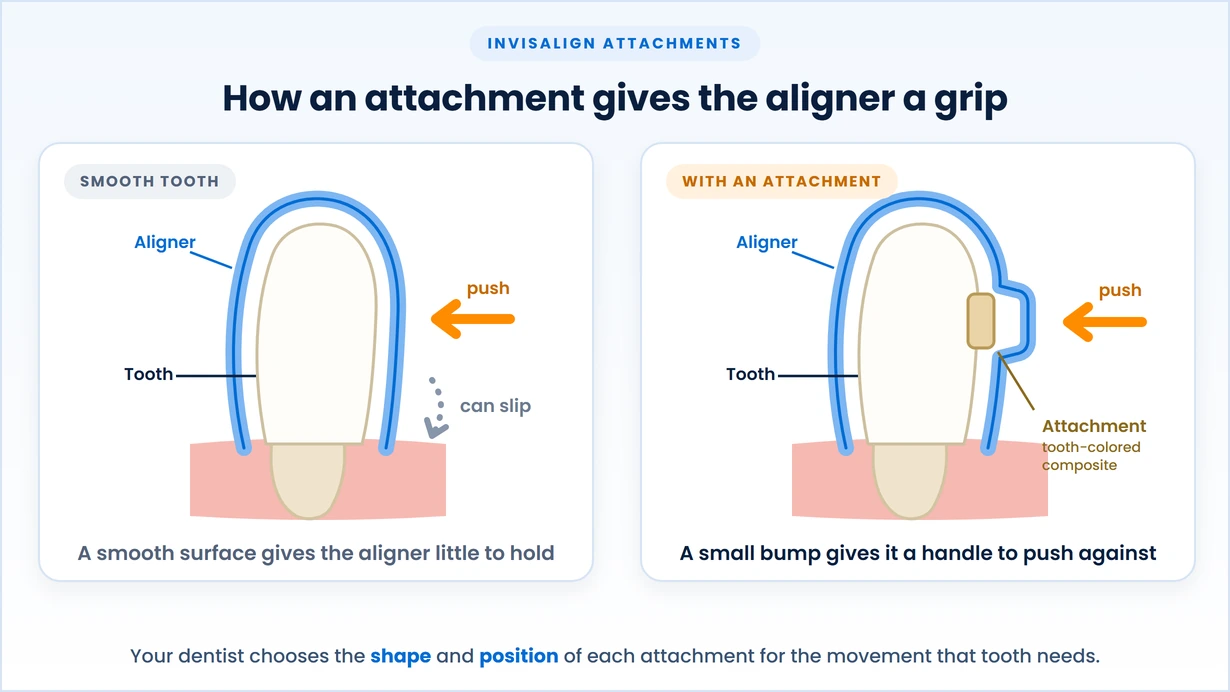
Attachments are custom-made to fit your teeth, and they come in different shapes, such as small rectangles, ovals, or slanted ridges. Your dentist chooses the shape and position for the movement each tooth needs. You might need attachments on every tooth or on just a couple of teeth that need extra support.
Why Do You Need Attachments for Invisalign?
Clear aligners move teeth by applying gentle, steady pressure. A smooth plastic shell handles some movements well, but others are harder.
A systematic review of clear aligner studies found that aligners were less effective at rotating rounded teeth and at extruding teeth (moving them further out of the gum) than at simpler movements, such as leveling the arches. The authors cautioned that the studies were few and varied, so treat this as a general pattern, not a rule for every tooth.
Attachments give the aligner a firmer hold, so it can push where it needs to.
Attachments can help with movements like:
- Rotating a twisted tooth, especially rounder teeth such as canines and premolars
- Extruding a tooth, which means gently drawing it further out of the gum so it lines up with its neighbors
- Moving the root, not just the crown, so the whole tooth ends up upright
- Closing larger gaps, where teeth need to slide sideways instead of just tipping
- Keeping aligners seated, so they stay firmly in place
In short, attachments help your teeth follow the treatment plan more closely.
Can You Get Invisalign Without Attachments?
Sometimes. How many attachments you need depends on how far, and in what way, your teeth need to move. Align Technology has also added aligner features, which it calls SmartForce aligner activation, that apply some forces directly from the aligner and can reduce the number of attachments certain cases need.
Every attachment should have a job in your treatment plan, so it’s fair to ask your dentist what each one is for.
Invisalign Buttons vs Attachments: What’s the Difference?
These words get mixed up, and even Invisalign’s own site uses “buttons” to mean attachments. When dentists plan treatment, though, the terms often mean different things:
| Term | What it is | What it does |
|---|---|---|
| Attachment | A tooth-colored composite bump bonded to a tooth | Gives the aligner a grip so it can move that tooth |
| Button | A small anchor bonded to a tooth | Holds an elastic (a tiny rubber band) |
| Hook or precision cut | A small notch built into the aligner itself | Holds an elastic |
Elastics add extra force to move teeth, and they’re often used to help correct the bite, such as an overbite or underbite. The American Association of Orthodontists explains elastics as the extra push that helps with stubborn bite issues. Not everyone needs them.
How Are Invisalign Attachments Placed?
Placing attachments is a quick bonding visit. Invisalign’s guide describes the process as straightforward and says it takes around 30 minutes. Here’s what usually happens:
- Your teeth are cleaned and dried so the bonding material sticks.
- A template aligner, with little spaces where the attachments go, is filled with tooth-colored composite resin and placed over your teeth.
- Gentle pressure helps the attachments adhere.
- A special light hardens the material.
- The template is removed, along with any extra bonding material, leaving the attachments in place.

Attachments are usually placed near the start of treatment and then stay on until the end. At Moa Dental, your dentist shows you the projected result before you commit, so that’s a good time to ask where your attachments will go and how many you’ll have.
What Do Invisalign Attachments Feel Like?
At first, you’ll probably notice the small bumps with your tongue and lips. Many people get used to them quickly. A few other things to expect:
- Mild soreness after placement. Invisalign says some discomfort after getting attachments should not last long.
- Slight pressure with each new set of aligners. This is normal and usually fades within a day or two.
- A learning curve for removing aligners. Follow your dentist’s instructions, and ease your aligners off with your fingertips instead of pulling hard at the front teeth.
Invisalign notes that over-the-counter pain relievers can help with mild discomfort. If soreness doesn’t ease, call your dentist.
Are Invisalign Attachments Noticeable?
Attachments are made from a tooth-colored material so they blend in, and your aligners are clear. Even so, some attachments are more visible than others depending on where they sit, and Invisalign notes that those on front teeth are easier to see than those on molars. Up close, without aligners in, you may be able to see the small bumps.
Want to know whether your treatment plan would include attachments?
How to Care for Your Teeth With Attachments
Attachments can hold onto plaque and food, so your daily routine matters. A few simple habits keep your teeth healthy:
- Brush around each attachment carefully, especially near the gumline.
- Floss daily to clean between teeth.
- Brush before putting aligners back in, so food isn’t trapped against your teeth.
- Take your aligners out to eat or drink anything other than water.
- Limit coffee, tea, red wine, and tobacco. Lab research shows composite aligner attachments can pick up stains from coffee and red wine.
- Don’t use your teeth as tools. Invisalign warns that this can loosen attachments or make them fall off.
- Wear your aligners 20 to 22 hours a day, as directed, so your teeth keep moving on schedule.
Keep up with your regular dental checkups and cleanings too, so plaque doesn’t build up around your attachments.
What If an Invisalign Attachment Falls Off?
Don’t worry. Contact your dentist’s office so it can be replaced. Invisalign says the office will schedule a time to do that. Ask whether you should keep wearing your current aligners until then, and don’t try to glue the attachment back on yourself.
How Are Invisalign Attachments Removed?
Attachments typically stay on for your whole treatment. Once your teeth reach their planned positions, your dentist removes them, and Invisalign describes this as a gentle, non-invasive procedure. The composite is taken off with dental instruments, and the tooth surface is polished smooth.
Next comes your retainer, which keeps your new smile in place. Our retainer instructions explain how to wear it.
If you’re wondering how to remove Invisalign attachments yourself, the answer is don’t. Picking, scraping, or filing them at home can damage your enamel.
Do Invisalign Attachments Damage Teeth?
Attachments are bonded to the surface of your teeth, not set into them, and they’re only meant to stay on during treatment. The step that deserves care is removal. In a 2025 lab study on extracted teeth, researchers found that removing composite attachments can leave tiny changes on the enamel surface, and the amount depended on which instruments were used. That’s one more reason to leave removal and polishing to your dentist.
Between visits, the most useful things you can do are brushing and flossing around your attachments carefully and never trying to remove one yourself.
Can You Whiten Your Teeth With Invisalign Attachments?
Talk to your dentist first. Whitening products are designed for natural teeth, and composite may not respond to them the same way, so the areas around your attachments could end up a slightly different shade. If an even result matters most, ask whether to wait until your attachments are removed. After that, a whitening visit can be a nice way to finish your treatment. You can learn more about professional teeth whitening at Moa Dental.
Invisalign Attachments for Teens and Adults
Attachments work the same way at any age. For teens, the main challenge is keeping up with brushing around attachments through busy days and snacks. For adults, a common question is how they’ll look at work. Attachments are made in a tooth-colored material so they blend in.
If you’re an adult thinking about clear aligners, our post on Invisalign for adults covers what to expect from start to finish.
Why Choose Moa Dental for Invisalign in Torrance?
Moa Dental is an Invisalign Blue Diamond provider for 2026, based on Align Technology’s tier as of July 2026. Our posts on Invisalign provider levels and how to choose an Invisalign provider explain what the levels mean and what to ask before you start. Here’s what treatment at Moa Dental includes:
- A quick, comfortable iTero 3D scan, with no messy impressions
- A digital treatment plan and smile preview, so you see your expected results before treatment begins
- Progress check-ins every 6 to 8 weeks
- A clear cost breakdown at your consultation, with flexible monthly payment plans (see our Invisalign cost guide)
New to Moa Dental? Our new patients page explains what to expect on your first visit. To ask whether your case would need attachments, call Moa Dental at (310) 530-2875 or visit us at 3226 Sepulveda Blvd, Torrance, CA 90505.
Invisalign is a registered trademark of Align Technology, Inc. SmartForce is a trademark of Align Technology, Inc.
Frequently Asked Questions
Do Invisalign attachments hurt?
Placing attachments is a bonding visit that Invisalign describes as straightforward, and it takes around 30 minutes. Some mild soreness afterward is normal, and Invisalign says it should not last long. Each new set of aligners may also feel snug for a day or two. If soreness lingers, call your dentist.
How long do Invisalign attachments stay on?
Attachments typically stay on for your whole treatment, which Invisalign says can last as little as six months. At Moa Dental, treatment typically takes 6 to 18 months. Your dentist removes the attachments once your teeth reach their planned positions.
How many Invisalign attachments will I need?
It depends on your plan. Invisalign says some patients need attachments on every tooth, while others need them on just a couple of teeth that need extra support. Your dentist decides based on how each tooth needs to move, so ask for the number, and the reason for each one, when you review your plan.
Can I remove Invisalign attachments myself?
No. Picking, scraping, or filing attachments at home can damage your enamel. Even in a dental setting, lab research shows the tools used for removal affect the enamel surface, which is why removal and polishing should be done by your dentist at the end of treatment.
What happens if an Invisalign attachment falls off?
Contact your dentist’s office as soon as you notice, so a replacement can be scheduled. In the meantime, ask whether you should keep wearing your current aligners, and don’t try to glue the attachment back on. Using your teeth as tools, such as biting pens or opening packages, can loosen attachments, so it’s best to avoid it.
Can I get Invisalign without attachments?
Sometimes, yes. Whether you need attachments depends on the movements your plan calls for. Align Technology’s SmartForce aligner activation applies some forces from the aligner itself, which can reduce how many attachments certain cases need, but it doesn’t replace them in every case. Ask your dentist what your plan calls for.
Do Invisalign attachments stain?
They can. Attachments are made of composite resin, and a 2025 lab study found that composite aligner attachments picked up stains from coffee and red wine. Brush around them, take your aligners out before drinking anything other than water, and limit tobacco, which can stain teeth and composite alike.
Are Invisalign buttons the same as attachments?
Not always. Invisalign’s own site uses “buttons” as another name for attachments, but dentists often use the word for a small anchor bonded to a tooth to hold an elastic. Attachments give the aligner a grip, while buttons and precision cuts hold elastics, which help correct the bite. Your dentist can tell you which ones are in your plan.